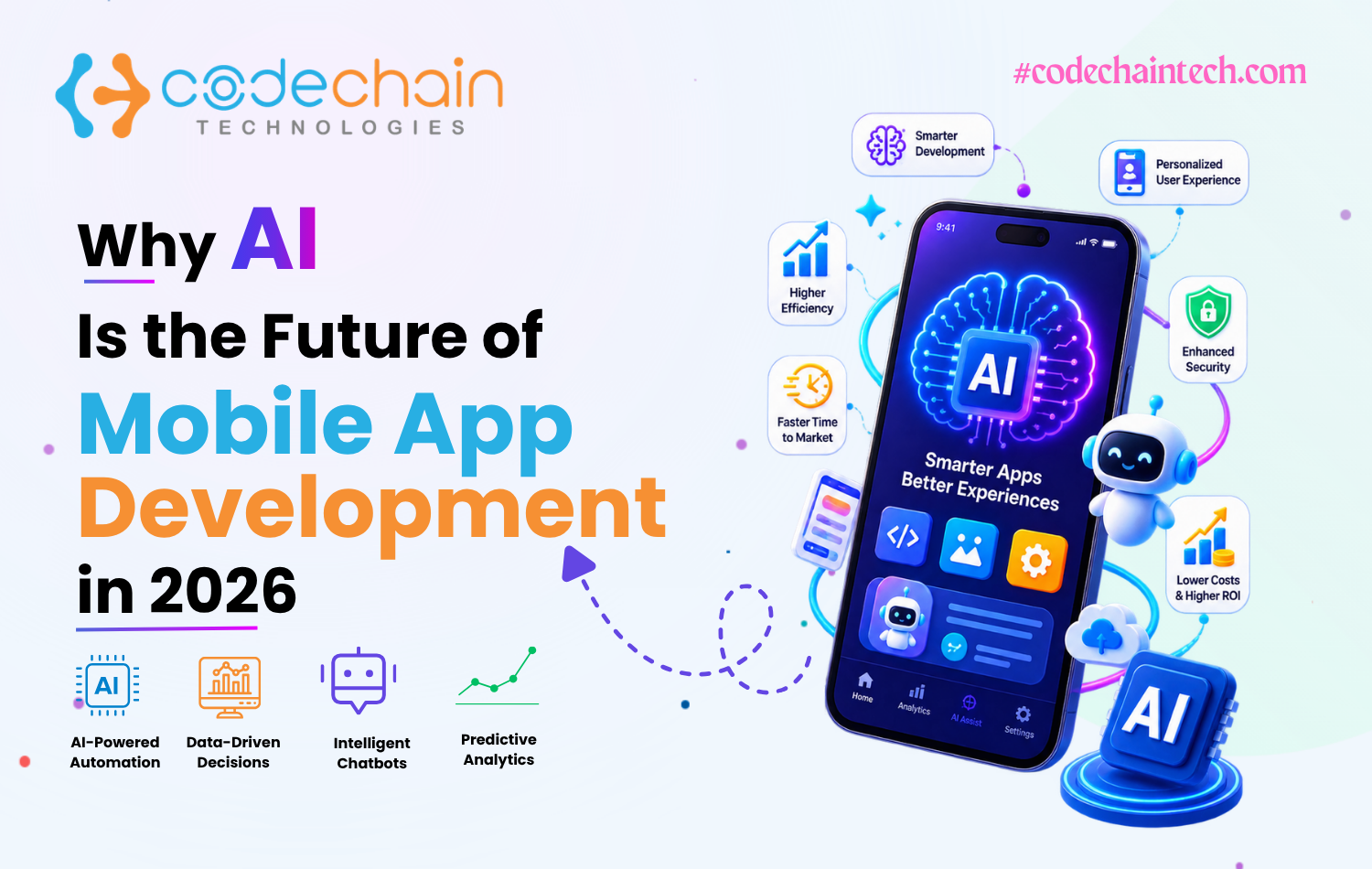
AI is reshaping mobile app development. Traditionally, mobile applications contained a fixed set of programmed features. This is no longer the case. Modern mobile applications utilize AI to develop user behavior models. Consequently, mobile applications have the ability to determine contextually relevant helpful actions and suggestions. Eventually, AI may alleviate the need to code mobile application responses by generating text responses to most, if not all, user interactions.
With companies realizing the financial upside of AI in mobile applications, the ubiquity of AI in mobile application development will grow exponentially.
In mobile applications, there are a plethora of repeatable tasks that are ideal candidates for AI automation.
This article includes a definition of AI in mobile application development, insights into AI in mobile applications, mobile application development tools, and other AI-related technologies, as well as the mobile application development process, and CodeChainTech's standpoint about AI in mobile application development, including the challenges associated with it.
What Is AI-Powered Mobile App Development?
AI in mobile application development enables mobile applications to perform text analysis and understanding, speech recognition, image analysis for differentiation and classification, content generation, and suggested actions.
Mobile apps generate outputs in response to user commands based on instructions coded into the apps. However, mobile apps with AI embedded in them are programmed to respond to user commands based on the user's behavioral patterns, contextual information, and supplemental data.
AI-related technologies such as generative AI are built upon foundational technologies of ML and NLP. Vision AI offers mobile applications the ability to capture and interpret images and text and even build contextual responses.
Finding solutions to users' challenges should be the primary focus when considering the integration of AI into mobile app development. Keeping pace with advances in technology should not be the justification for integrating AI in a mobile application.
How Does AI Work Inside a Mobile App?
There are several challenges associated with the integration of AI into mobile apps. Though the architectural design may differ for most mobile apps, the process is fairly linear.
User Input
There are many digital data formats, such as audio, text, images, and graphics, that mobile AI apps are capable of accepting user inputs.
Data Processing
For an AI service to be useful in the app, it must be able to process the data and offer useful responses.
AI Model Analysis
After the data has been processed, the AI service offers conclusions and suggestions for the issues that the user presents.
Response Generation
Based on the suggestions, the AI service generates a response to the user through the mobile app.
Mobile App Response
The AI service embedded in the mobile app responds to the user's request by offering the product the user was previously browsing, improving user experience.
Key AI technologies used in mobile app development
AI can be applied in multiple ways in a portable device.
Machine Learning
Apps can identify patterns, make predictions, and increase their own intelligence while detecting fraudulent activity in an app.
Generative AI
Generative AI will write summaries or prompt responses and create art. It is solely responsible for content generation apps and assistants/chatbots.
Natural Language Processing (NLP)
This allows an application to verbally communicate and understand language. This technology is largely used in customer service text chat applications.
Computer Vision
This technology allows an application to understand and process images and graphics. This technology is instrumental in optical character recognition, image classification, and object detection.
Speech Recognition
This technology allows users to interact with an app through speech. This technology is useful for voice command and requesting text and image searches.
Predictive Analytics
This technology is essentially learning and identifying data patterns to project probable events that may occur and is useful for companies that implement it to suggest actions to customers while learning their tastes and preferences, thus answering their needs.
The mobile application's clear objectives and trade-offs are the biggest determinants of which AI technology to select.
AI technology is multifarious and practically unfettered in its applications.
E-Commerce
In e-commerce, AI can analyze customer data and purchase histories for purposeful searches and suggestive purchasing.
Health
Among the user data privacy/safety trade-offs, many AI-based services can do scheduling, give tips and suggestions, digital health, and several other services.
Banking and FinTech
AI can help with customer service queries and the automation of financial and customer data investigations for fraud detection.
Education
Automation of intelligent applications that aid customers in navigating and comprehending instructional resources.
Food Delivery
AI can help customers' past food delivery data to personalize their meal and boost delivery operations.
Business and Productivity
Data analysis is integral to AI and helps automate business operations and customer support.
AI works best when used to provide major solutions rather than minor supporting ones.
Implement AI Features Into Apps
Different user segments will require different AI features for their mobile apps.
AI Chatbots
With this feature, apps increase overall customer service by employing built-in virtual assistants to help customers find answers to commonly asked questions.
Smart Search
Relaxes the constraints of keyword-only searches and allows for the AI to perform a lot more helpful contextual searches.
Personalized recommendations
Help enable apps by suggesting what users might like to do next based on their behavior and interests. These systems can also help predict user purchases.
Voice Assistants
Allow users to control an app by spoken commands with no keyboards.
Image Recognition
Allows apps to capture and classify images and other documents using computer vision. It also interprets them.
Predictive Notifications
Unlike traditional notifications that are sent to all users, AI explains user behavior and presents personalized information to users.
Automation of customer support
Systems interpret user requests by themselves, allowing customer support staff to handle difficult tasks.
When creating apps, the main AI features must be included. Overabundance of AI-based features may lead to a poorly designed app.
Real-Life Example
A practical example of mobile application development by CodeChain Technologies is Hisab Book, a financial management application designed to help users organize their income and expenses.
Hisab Book provides functionality for recording income and expenses, automatic calculations, monthly reports, expense graphs, multiple account profiles, and customizable categories. These features help users manage their financial records in a structured digital format.
Tracking expenses is a challenge that has, until the introduction of Hisab Book, evaded a simple solution, and as efficiently as Hisab Book does, it is done in just a few steps. With Hisab Book's app, users can track both income and expenses. It showcases CodeChain Technologies' ability to provide users with solutions to problems.
It illustrates to Code Chain Technologies why users are attracted to apps that are time-effective.
Hisab Book is an excellent mobile app for all prospective developers.
AI Is Now Easier to Integrate into Mobile Apps
AI integration is now possible where there was previously none, because users are able to utilize a mobile app's already developed core systems.
Identify Use Case
Here, you describe the problem you will solve with your AI implementation. Challenges you might describe include, but are not limited to, making smarter searches or automating customer support.
Inspect Current Setup
You will have to examine the mobile app's backend, frontend, APIs, and their related infrastructure: the mobile app's database and security and authentication frameworks.
Pick Your AI Solution
Once the mobile app's structure is assessed, you can pick the AI solution that best addresses your defined use case.
Preparing and Structuring Data
Since AI is highly solutions-driven, as are users, the quality of input data will define the quality of output.
AI Backend Integration
As the mobile app and AI services are connected to the backend servers, we can use the backend to implement AI.
AI Connected to Mobile App
AI outputs can be connected to the mobile app to eliminate certain data-intensive app activities.
AI Testing and Monitoring
The goal is to ensure the safety and security of the AI along with the appropriate response time.
We will develop our AI components in phases to understand the value of each component and simplify the development and integration of subsequent components.
AI Technology Stack for Mobile App
An AI mobile app consists of Android as well as iOS app versions with a cloud AI backend and a database. The app features and requirements determine the app scalability and technology used for each app version.
Frontend & Mobile
- Flutter: App development for cross-platform.
- React Native: App development for cross-platform with native UI.
- Android: For version for Android.
- iOS: For version for iOS.
Backend
- Node.js: For creating real-time backend services.
- Python: For AI, ML, and data backends.
- PHP: For mobile app APIs and backend services.
- .NET: For creating secure, enterprise-grade, and scalable backends.
AI and ML
- Machine Learning: For user app personalization and predictive ML and pattern discovery.
- Generative AI Models: For text generation, text writing, text summarization, and content creation.
- Natural Language Processing: is the ability of a computer to analyze and interpret text in a natural human form.
- Computer Vision: is the ability to interpret data in the form of an image.
- AI APIs: are AI model building blocks that developers can use to avoid building an AI model from scratch.
Cloud Infrastructure
- Amazon Web Services (AWS): AWS offers a variety of cloud building blocks, from AI to analytics to storage to databases.
- Microsoft Azure: Azure offers cloud building blocks as well as a variety of AI services.
- Google Cloud: Google Cloud offers cloud services as well as AI and ML for cloud applications.
Database Technologies
- MySQL: MySQL is a relational application data management system.
- PostgreSQL: PostgreSQL is a complex application data management system.
- MongoDB: MongoDB is a NoSQL data management system best suited for data that is constantly and rapidly changing.
For most applications, a combination of technologies makes it easy to maintain an application that is flexible, secure, fast, and powerful.
Challenges and Best Practices for AI Mobile App Development
Using AI in a mobile app gives a company a competitive advantage. Each company should weigh the pros and cons before using AI in their mobile application.
Data Privacy
Many mobile applications keep or process sensitive data. It is the mobile app's responsibility to determine the correct policy to secure the data's privacy and safety.
AI Accuracy
In the case of processes that impact the outcome of a result, undesirable and unforeseen results should be controlled and validated with the necessary measures to minimize risk.
Performance
The cost and efficiency of a system are affected by the integration of AI. Therefore, the architecture must be chosen carefully.
API Dependence
The cost, the service consumption level, and the dependencies and limits of an AI service must be taken into account when creating an application.
Maintenance
Active software development and adaptive AI require continuous construction and updating. Some of the many reasons for this are user data and changing business requirements.
AI systems must be designed keeping the entire architecture of an application in mind. At CodeChainTech, we have significant experience in building application architectures and can design the framework, keeping user data secure, testing AI responses, evaluating system performance, and many other things.
How CodeChainTech Builds AI-Powered Mobile Apps
There are many advantages to using CodeChainTech for your mobile app AI development. First you need to identify the business problem. Next, you may choose technologies for creating a mobile app with a good UI/UX.
CodeChainTech services are available throughout the mobile app development process, from creative UI/UX design and app creation to AI development, back and front end, APIs, and app testing and deployment.
Using Flutter, React Native, Node.js, plus other services with related AI APIs, and Python is a good choice for developing an AI-based mobile app, along with Android and iOS.
To create a successful app, design thinking must be centered on solving a user's problem. Users expect safe and effective apps to incorporate AI.
Conclusion
Most companies find AI appealing because of the mobile app advantage of instant, personalized, smart, and automated experiences. There are multiple ways of integrating AI into mobile apps to help businesses, for instance, with product recommendation, predictive actions, chatbots, and vision AI.
Companies have to identify why they want the AI apps built and should protect their user data first, followed by adopting the correct AI technique and building architecture to support business growth.
The age of AI processing, starting from 2026, will ultimately let mobile apps generate integrated digital products. CodeChainTech, using AI to develop mobile apps will touch many areas of app design, including UI/UX, mobile technology, and cloud and backend intersections. The focus should be on building only useful apps.
As a tech company, our aim is to help clients build mobile apps with contemporary technology integrated with mobile app development.
FAQs
-
1
What is AI in mobile app development?
AI in mobile apps incorporates elements like personalization and customization, predictive analysis, chatbots, and image recognition.
-
2
What is the importance of AI in mobile app development?
AI offers the ability to perform a variety of operations such as product search and suggestion, image classification, chatbots, commands, predictions, risk and fraud detection, recommendations, and personalization.
-
3
Can AI be integrated in a mobile app that is already functioning?
Yes, this can be achieved through the integration of APIs and other frameworks, AI models, and AI services. The correct approach to take is relative to the architecture of the functioning mobile application and its purposes.
-
4
What kinds of AI technology are used in mobile app development?
AI technologies include Machine Learning (ML), advanced image and speech recognition, Natural Language Processing (NLP), generative AI, and predictive analytics.
-
5
How do mobile apps benefit from AI?
The incorporation of AI facilitates mobile apps, the ability to provide assistance and support to users, and the building of a UI that is more contextual and experiential.
-
6
Is AI a good fit for small business mobile apps?
It gives small businesses the ability to offer automated support to customers, suggest products, personalize business content, and further support and automate business processes and offer analysis. Most of the applications that are designed do not require sophisticated systems to support their operations.
-
7
What technologies are used to develop AI mobile apps?
Cloud technologies, AI, APIs, databases, and integration technologies such as Flutter, React Native, Node.js, and .NET can be employed to satisfy the specific needs of a project.
-
8
What kind of issues could developers expect to face when making AI mobile apps?
When developing AI mobile apps, developers may face issues with integration, API reliance, app performance, scalability, stable data, accuracy of AI, maintenance, and data privacy.
-
9
How can companies use AI to improve their existing mobile apps?
After choosing a use case, companies need to evaluate their app's existing architecture to determine which AI option is feasible. The next steps are preparing the data and integrating the AI solution with the company's back-end services. Lastly, connect the AI to the app interface via the UI and test the integration.
-
10
In what manner will AI-based mobile app development become essential in 2026?
AI enables app automation and customization, allowing mobile apps to respond to user needs. Since users' expectations continually increase, mobile apps based on AI will be more interactive and adaptive.